
From Teso and Karamoja to Geneva: Bringing Grassroots Concerns into Global Business and Human Rights Discussions
The consequences of international business decisions are often experienced in communities geographically distant from where those decisions are made. Yet the organisations documenting these consequences frequently face considerable barriers to participating in the institutions where corporate responsibility and human rights are discussed.
From 23 to 25 November 2026, the Palais des Nations in Geneva hosted the 15th United Nations Forum on Business and Human Rights, bringing together governments, businesses, civil society organisations and human rights experts to examine the relationship between commercial activities and human rights.
Through its Global South Access programme, Global Divide facilitated the pro bono representation of Shine Africa Foundation (SAF-TESO), Uganda, bringing perspectives from communities in Teso and Karamoja into international discussions on corporate accountability, natural resource governance and meaningful stakeholder engagement.
Connecting grassroots experiences with international policy
Established in 2009, SAF-TESO is an indigenous non-profit organisation rooted in Uganda’s Teso sub-region. It operates both as a direct programme implementer and as a coordinating hub for a network of over 300 civil society organisations, including youth-led and women-led organisations, community-based groups and NGOs.
Its work reflects the interconnected nature of the challenges facing communities in Teso and Karamoja. Environmental degradation, limited livelihood opportunities, inadequate healthcare access and human rights concerns rarely exist independently of one another. SAF-TESO addresses these challenges through an integrated approach encompassing environmental justice, public health, community empowerment, peacebuilding and sustainable development.
Among its current initiatives is the development of formally organised waste-picker cooperatives in Soroti City and Serere District, connecting environmental sustainability with economic inclusion and community livelihoods.
These experiences provide a practical foundation for contributing to international discussions on how businesses interact with communities, how economic opportunities are distributed and how development can be pursued without compromising human rights.
Taking the floor at the United Nations
On 23 November, Global Divide’s Geneva-based policy representative, Gift Flavia Onwuelo, took the floor on behalf of SAF-TESO during the Forum’s session on meaningful stakeholder engagement in human rights due diligence.
The intervention raised concerns about the distance between communities affected by business activities and the companies and investors whose decisions influence their land, resources and livelihoods. It also questioned the adequacy of consultation processes in which communities are informed of commercial decisions only after those decisions have been made.
“Sometimes corporate philanthropy is offered instead of real engagement. But charity cannot make up for exploitation.”
The intervention proceeded to examine a less frequently discussed dimension of stakeholder engagement: its affordability. If grassroots organisations lack the resources to participate in the institutions where corporate responsibility is discussed, how can the evidence they gather meaningfully inform corporate and investor decisions?
SAF-TESO’s contribution therefore addressed not only the responsibilities of businesses towards affected communities, but also the structural conditions that determine whether those communities can participate in discussions concerning their rights.
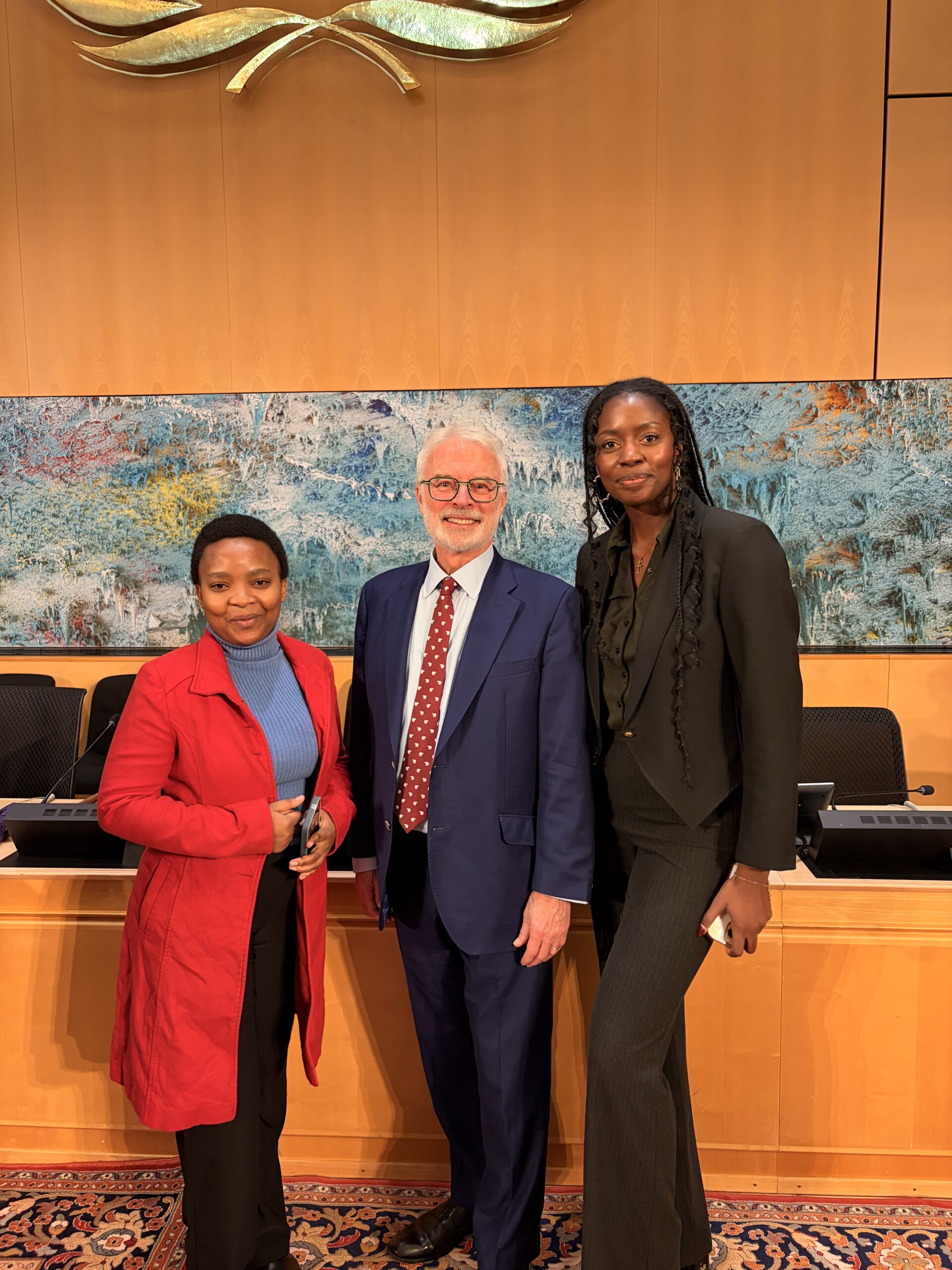
Global Divide’s policy representative, Gift Flavia Onwuelo, with Professor Damilola Olawuyi, SAN, member of the UN Working Group on Business and Human Rights, during the 15th United Nations Forum on Business and Human Rights at the Palais des Nations, Geneva, November 2026.
Beyond delivering an intervention
Meaningful international policy representation extends beyond securing an opportunity to speak. It also involves understanding emerging institutional developments, establishing relevant relationships and identifying opportunities that can strengthen an organisation’s existing work.
During the Forum, Global Divide monitored four policy sessions covering corporate accountability, human rights due diligence, free, prior and informed consent, and meaningful stakeholder engagement. Our representative also engaged with Professor Damilola Olawuyi, SAN, and Professor Robert McCorquodale, member and Chair of the UN Working Group on Business and Human Rights, respectively.
The engagement established seven new contacts across the United Nations, civil society and the private sector, with potential opportunities for collaboration in environmental justice, community-led advocacy, circular economy innovation and regional peacebuilding.
For SAF-TESO, these opportunities provide avenues for connecting its existing community programmes with wider institutional discussions and exploring partnerships that could support its long-term organisational priorities.
Making international representation more accessible
SAF-TESO’s engagement illustrates an important distinction between formal access to international institutions and the practical capacity to participate in them. An organisation may possess the relevant accreditation, substantive expertise and community relationships, yet remain constrained by the financial and administrative demands of international participation.
Through Global Divide’s representation model, SAF-TESO was able to communicate its advocacy priorities, follow relevant policy discussions and establish international contacts without incurring international travel or representation costs.
Our Global South Access programme is founded on the recognition that organisations working closest to pressing development and human rights challenges should not be excluded from international policy discussions because of the resources required to access them.
The geographical distance between Teso and Geneva should not determine the extent to which the experiences of communities in Teso inform international policymaking. Making that distance less consequential is central to the work of Global Divide.